

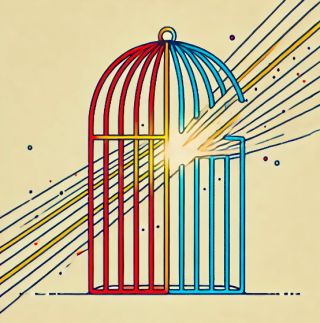
Supply: Artwork: DALL-E/OpenAI
It’s essential to argue that synthetic intelligence belongs in a cage—safely confined in the back of guardrails set by way of a longtime orthodoxy. However what in regards to the price of unlocked AI, the place computational energy is unleashed to discover with out constraints? This raises an very important query: does controlling AI for reliability and precision possibility by chance restricting its transformative attainable? Let’s take a more in-depth glance.
Dynamic AI: Inventive Freedom vs. Keep watch over
AI is revolutionizing how we predict, reason why, and resolve issues. Its talent to find connections, generate novel insights, and help in decision-making has unlocked chances as soon as past our creativeness. Massive language fashions (LLMs) thrive on dynamic webs of data, connecting ideas in sudden, frequently transformative tactics. This pliability fosters creativity and innovation, but it comes with dangers: hallucinations, inconsistencies, or outright mistakes. Nowadays, we’re seeing new gear like Chain of Concept (CoT) reasoning and Semantic AI that experience the possible to beef up software, but in addition impose positive computation restrictions.
Chain of Concept: A Harness for AI Reasoning
CoT reasoning buildings AI’s outputs by way of breaking issues into sequential steps, similar to people do. It’s particularly treasured for duties requiring logical consistency, akin to fixing equations or inspecting prison arguments. Through narrowing focal point to a step by step trail, CoT guarantees readability and accuracy.
But, this focal point can obstruct lateral considering, suppressing the inventive leaps that make LLMs so tough. CoT can really feel like a harness—providing regulate and reliability however dampening the liberty to roam. Whilst it’s an efficient software, it raises questions on how a lot construction AI actually must thrive.
Semantic AI: The Fence of Ontologies
Semantic AI imposes a distinct more or less construction via ontologies—human-defined frameworks that prepare wisdom into classes and relationships. In well being care, for example, an ontology maps signs to sicknesses, making sure AI adheres to established scientific experience. This way supplies explainability and precision, important for high-stakes domain names like medication, finance, or regulation.
However ontologies are inherently inflexible, reflecting the biases and obstacles in their creators. Through confining AI to predefined frameworks, Semantic AI dangers combating the exploration of novel patterns or connections. If CoT is a comfortable harness, Semantic AI is extra like a fence—grounding AI however probably blockading paths to innovation.
Balancing Creativity and Keep watch over
CoT and Semantic AI resolve the similar drawback: making AI outputs coherent, correct, and faithful. But their imposed construction dangers confining AI’s attainable. Imagine this case:
A well being care LLM tasked with diagnosing an extraordinary illness will depend on Semantic AI for scientific wisdom and CoT for logical reasoning. This mixture is robust—till the analysis hinges on a singular connection out of doors the ontology or reasoning chain. Right here, gear supposed to reinforce AI inadvertently prohibit its talent to discover the sudden.
This stress—between creativity and regulate, freedom and constraint—defines how we form AI’s long run.
When Keep watch over Turns into a Cage
The problem isn’t simply technical; it’s philosophical. Through making use of gear like CoT and Semantic AI, we’re shaping how AI thinks and what it’s allowed to take into accounts. Those gear mirror human values: precision over creativity, protection over exploration, consensus over discovery. However who makes a decision how a lot regulate is an excessive amount of?
Ontologies are human creations, formed by way of assumptions and biases. If overly inflexible, they develop into obstacles fairly than foundations for innovation. In a similar fashion, CoT can fortify slim considering if its reasoning steps are too constrained. At their best possible, those gear foster collaboration between people and AI. At their worst, they possibility decreasing AI to a device of regulate, restricting its talent to encourage or marvel us.
Fending off the Generation Zoo
As we form the way forward for AI—and because it shapes our long run too—we want to cope with no longer handiest the technical demanding situations but in addition the deeper societal and philosophical ones. Continuously, regulate over AI is reactive—pushed much less by way of technical necessity and extra by way of societal and political considerations, some legitimate, others rooted in biases or misconceptions.
However AI isn’t a device to be locked away. After we impose an excessive amount of regulate, we possibility turning it into an show off in a “era zoo”—confined to a predictable, useful cage the place it can’t problem us, marvel us, or go beyond the limits we set. AI’s attainable lies no longer in compliance however in its talent to increase human creativity and redefine what’s conceivable.
This isn’t about putting a stability; it’s about making a call. Do we would like AI to easily meet expectancies, or are we in a position to consider it to discover uncharted territory? To stifle its brilliance is to stifle our personal. The way forward for human ingenuity might smartly rely on our willingness to let AI roam past the confines we impose. It is going to be difficult.
You must be logged in to post a comment Login