



Supply: Symbol by way of Steffi Timm from Pixabay
Bias and cognitive bias have gained vital consideration from researchers and practitioners during the last half-century. Wikipedia’s Record of Cognitive Biases supplies an amazing array of classes and explicit biases.1 At their core, biases constitute not anything greater than easy inclinations—patterns in how we job knowledge, make selections, and draw conclusions. When you glance in the course of the listing of cognitive biases, you’ll see tendency seems many times.2 So, biases information the sorts of knowledge we depend on and the methods we use to come to a decision.
Not too long ago, Oeberst and Imhoff (2023) argued that many biases most likely come again to a mix of a few basic perception plus belief-consistent knowledge processing. In different phrases, they argued that we possess a collection of basic ideals (see Determine 1), and we job knowledge in techniques which might be in step with the ones ideals (i.e., affirmation bias).
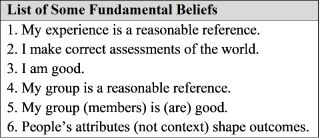
Determine 1. Record of basic ideals
Supply: Tailored from Oeberst and Imhoff (2023)
I firstly considered offering a breakdown of Oeberst and Imhoff’s standpoint, however Smets (2024) already did an out of this world process of that. As an alternative, what I sought after to do right here used to be to dive extra deeply into one of the most implications posed by way of the relationship of a number of biases to a way smaller set of foundational ideals. There are 3 explicit implications that warrant additional point out:
- Bias energy depends at the energy of basic ideals.
- The energy of basic ideals is prone to range throughout contexts.
- Motivated reasoning is most likely extra distinguished when basic ideals are extra strongly hooked up to our sense of self.
Bias energy depends at the energy of basic ideals
Oeberst and Imhoff (2023) outlined ideals as “hypotheses about some facet of the sector that come together with the perception of accuracy—both as a result of folks read about ideals’ fact standing or as a result of they have already got an opinion concerning the accuracy of the ideals.” In different phrases, a perception is one thing we cling to be true, irrespective of whether or not it’s justified or no longer. And whilst Determine 1 supplies a listing of a few basic ideals, this listing is just supposed to display how a couple of biases grow to be manifestations of the similar basic perception.
The Oeberst and Imhoff standpoint aligns neatly with the only proposed by way of Bach and Schenke (2017), who argued that biases function predictions we make a few given state of affairs according to our prior reports and salient situational cues. The extra assured we’re in the ones predictions or ideals, the more potent the unfairness might be. For instance, for those who’re purchasing for a brand new automotive, and also you strongly imagine international automobiles are a better option, you then’re prone to handiest imagine details about automobiles that align along with your perception.3 But when your perception isn’t as sturdy, you’ll be extra prepared to fairly imagine details about American automobiles.
The important thing factor isn’t whether or not we cling a basic perception however how strongly we cling it. The more potent the conclusion, the more potent the unfairness.
The energy of basic ideals is prone to range throughout contexts
Within the prior instance, there used to be a selected perception at play (about international automobiles). However that particular perception is hooked up with #1 and #2 in Determine 1. There should be a explanation why you possessed the conclusion, and that explanation why is prone to come again to enjoy (both direct or vicarious). And provided that you strongly believed that the evaluation used to be proper would that bias have risen to the extent of being a robust bias.4
Those ideals had been explicit to the context of buying a brand new automotive. But if confronted with different selections—purchasing a vacuum, pc, or dishwasher—chances are you’ll depend on other reports and ideology. The energy of your bias will shift relying on how a lot enjoy you might have in each and every context and the energy of the ones ideals.
And that is the most important implication of the argument Oeberst and Imhoff put forth. Even supposing the listing in Determine 1 used to be a complete and whole listing of basic ideals, the energy of the ones basic ideals is prone to range according to the particular situational context. We could have sturdy basic ideals in some contexts and far weaker basic ideals in different contexts. So much depends upon the stage to which one has enjoy associated with that situational context.
Motivated reasoning is most likely extra distinguished when basic ideals are extra strongly hooked up to our sense of self
Considered one of Oeberst and Imhoff’s central claims is that motivated reasoning isn’t a vital part in their framework. Even if I used to be firstly skeptical of this declare, having learn their argument, I understood their level. As I argued prior to now, motivated reasoning happens when our objectives and/or values skew the decision-making job towards conclusions that align with the ones objectives/values. That is generally framed as having a desired conclusion and therefore reasoning our method into that conclusion (if conceivable).
However this assumes that basic ideals are essentially hooked up to our objectives/values. However such an assumption can be misguided. No reason is needed to imagine that our enjoy is an affordable reference nor that we make proper exams of the sector. A trifling generalization from our personal reports (e.g., I depend on my enjoy so much, and I most often make fairly excellent selections) can be enough to guide us to own each ideals.
For instance, your enjoy would possibly inform you you’ve effectively navigated visitors patterns for years. You’ve pushed effectively via a couple of prerequisites (e.g., adversarial climate, congestion) and maintained a fairly excellent riding document. Through the years, you’ve come to imagine you’re a excellent motive force. This perception didn’t increase on account of any explicit price or function; it’s merely a generalization out of your previous reports.
On the other hand, the conclusion that you simply’re a excellent motive force can nonetheless bias your decision-making. Chances are you’ll overestimate your skill to care for dangerous riding prerequisites or underestimate the opportunity of creating a mistake, although a variety of proof suggests you will have to power extra cautiously. The conclusion isn’t hooked up to a price like protection,5 however it nonetheless results in biases in the way you assess your riding talents and dangers at the street.
But, this bias turns into a lot more potent for those who connect non-public importance to being a excellent motive force—if it’s hooked up for your identification or how you need to be perceived. Right here, the unfairness shifts from a easy generalization to motivated reasoning, making it more difficult to override, even within the face of conflicting proof.
Wrapping issues up
Human decision-making is regularly framed the use of a dual-process conceptualization, although, as I prior to now argued, any such standpoint is overly simplistic and an faulty view of the way in which we make selections. However in that conceptualization, extra mindful analytical considering is the prescribed means for overriding biased conclusions. On the other hand, some of the necessary issues that Oeberst and Imhoff made of their article is that considering extra consciously concerning the biased conclusion—until it’s when it comes to a small global drawback6—is generally no longer going to have an effect on the belief we succeed in.
It is because the unfairness isn’t the issue. The prejudice is simply a logical manifestation of a few basic underlying perception(s). So, if we wish to alternate the biased reaction, we want to be prepared to reconsider (or a minimum of mood) the energy of the ones underlying ideals.
This is the reason many debiasing methods fall brief. They try to proper the unfairness with out addressing the elemental ideals that reinforce it. If we center of attention handiest on seeking to suppress biased conclusions with out wondering the underlying ideals, we’re not going to peer significant or lasting alternate. Additionally, when those underlying ideals connect with our identification—whether or not associated with political, social, or non-public values—motivated reasoning could make it even more difficult to regulate the ones ideals. In such circumstances, we’re no longer simply difficult a cognitive bias, however a perception this is intertwined with our sense of self, making alternate a lot more tough.
To triumph over biased conclusions, we should transfer past analytical considering and increase an consciousness of our underlying ideals, closing open to re-examining them. This comes to wondering the principles of our considering, a troublesome however vital step in lowering bias that can result in error.7




![VVS: Meet the Emerging K-Pop Woman Crew Set to Shine Like Diamonds [Teaser Images] – Kpoppie](https://i1.wp.com/kpoppie.com/wp-content/uploads/2025/04/vvs-man-100.jpg?w=100&resize=100,100&ssl=1 "VVS: Meet the Emerging K-Pop Woman Crew Set to Shine Like Diamonds [Teaser Images] – Kpoppie")





You must be logged in to post a comment Login