

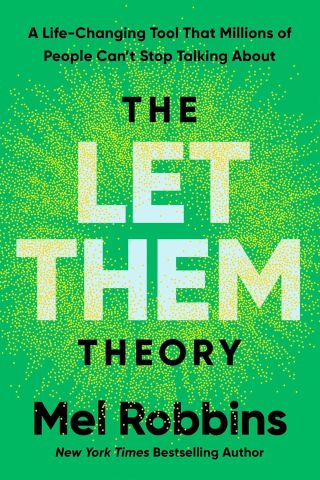
Supply: Mel Robbins / Hay Area LLC
The brand new 12 months is crucial second to consider easy methods to navigate tough relationships. Now trending on social media is a catchphrase that comes from Mel Robbins, podcaster and writer of The Let Them Concept. This concept encourages the ones suffering in poisonous relationships to easily permit their nemesis to act as they are going to.
Right here’s a pattern of the way Robbins summarizes her idea, from a weblog put up at the matter.
“Allow them to pass judgement on you.
Allow them to misunderstand you.
Allow them to gossip about you.
Allow them to be ‘proper.’
Allow them to now not such as you.
Allow them to now not talk to you…
Kindly step apart and ‘LET THEM.…’
Allow them to cross.”
Must You “Let Them”?
Robbins has unquestionably get a hold of a catchy (if reductive) word that gives some prospect of convenience to the harm and rejected. It coincides with every other present pattern: familial estrangement.
Regardless that “there’s quite little knowledge at the matter,” Anna Russell studies in The New Yorker, anecdotal proof signifies that “increasingly younger individuals are reducing out their folks. Others suppose that we’re merely turning into extra clear about it.” An building up in those estrangements, she says, will also be attributed to “converting notions of what constitutes destructive, abusive, traumatizing or neglectful habits.”
Admittedly, some relationships aren’t value maintaining. If the connection is chronically disrespectful, injurious, or tormenting, it can be perfect to “allow them to cross.” However threat lies in categorically pushing aside or forsaking relationships when problems get up.
Believe a counterintuitive but basic and doubtlessly transformative reality to warfare: It can be a chance for expansion. In any dating, disagreements are inevitable and could also be deeply unsettling.
However the conflict may just be offering perception into ourselves, elevating a elementary query: Why do I believe so strongly about this factor? A dispute might highlight one thing we want to cope with in ourselves, now not simply within the dating. A next dialogue generally is a pathway to larger intimacy.
What If You Heard Them As an alternative?
Dr. Donna Hicks, an affiliate on the Weatherhead Middle for Global Affairs at Harvard College, has labored as a 3rd‐birthday celebration facilitator in one of the crucial international’s maximum intractable conflicts. She has drawn upon her stories in mediating world disputes to create a type for verbal exchange that applies to households in addition to to international locations.
In her e-book Dignity: Its Crucial Function in Resolving Struggle, she outlines her means, which goals to rebuild relationships via requiring a mutual honoring of human dignity.
Dignity, she explains, invests each and every folks with an inherent price and value. When persons are denied their dignity, they really feel inconsequential and inappropriate; they turn out to be green with envy, even enraged, as a result of they really feel they don’t seem to be observed or heard. They ask questions like: How are you able to deal with me like this? Can’t you spot we’re human beings? Can’t you spot we’re struggling?
Dr. Hicks then outlines the 4 vital steps to start out the method of resolving disputes:
- Take a seat down in combination.
- Pay attention with out interrupting or difficult each and every different’s tales; pay attention to hunt figuring out. (All mavens agree that true listening— the place one individual in truth takes in what the opposite individual is pronouncing—is the most important to reconciliation.)
- Recognize and acknowledge what the opposite has been thru. (When each and every birthday celebration hears the opposite’s stories, neither birthday celebration can dehumanize or exclude the opposite from the ethical group.)
- Honor and recognize each and every different’s integrity and, in doing so, create a mutual bond.
For this procedure to be triumphant, ten very important components of dignity will have to be commemorated, Dr. Hicks says. She lists those because the vital components:
- Acceptance of identification: Settle for others as their unique selves, with out concern of judgment, irrespective of race, faith, ethnicity, gender, magnificence, sexual orientation, age, or incapacity. All or any of those traits could also be on the core of a person’s identification.
- Inclusion: Make others really feel they belong to a circle of relatives, group, group, or country.
- Protection: Make folks really feel secure from physically hurt, humiliation, and retribution.
- Acknowledgment: Pay attention, listen, and validate others’ emotions and stories.
- Popularity: Validate others for his or her contributions, abilities, laborious paintings, and compassion.
- Equity: Deal with folks justly and even-handedly.
- The good thing about the doubt: Suppose individuals are devoted, with just right motives.
- Working out: Permit others to give an explanation for and categorical themselves whilst actively being attentive to what they are saying.
- Independence: Give folks hope and a way of keep watch over via encouraging them to behave on their very own behalf.
- Responsibility: Take accountability in your movements and, if vital, make an apology and alter your habits.
Relationships Crucial Reads
It’s essential to notice that following the Hicks Dignity Type is prone to require sooner or later acknowledging and speaking about disgrace. Typically, Dr. Hicks explains, folks generally tend to disclaim disgrace somewhat than talk about it.
In Dr. Hicks’s revel in, the Dignity Type finds that in reality better than its separate tales: Crying out for alternate, each events are a part of a bigger disorder. “The largest lesson I discovered from those encounters is that vulnerability is the place the facility lies,” Dr. Hicks writes. “The magic occurs after we reveal the reality to ourselves and others and are in the end set unfastened via it… After we honor others’ dignity, we beef up our personal.”
“Let Them,” I imagine, gives none of this magic. Ignoring others’ offensive phrases or movements—with out responsibility, exploration, or answer—merely sweeps issues underneath the rug. The ensuing “peace” could also be briefly at ease, however it will also be inauthentic—and in the end unsatisfying.
True, some scenarios simply can’t be fastened. “Let Them,” alternatively, chooses to not even check out.
You must be logged in to post a comment Login