


All through graduate faculty, I attended my first regional psychology convention, a gathering of both the Southeastern or Southwestern Mental Affiliation. (Each met in New Orleans that 12 months.) There, I met (and spoke with) my first psychology superstar, probably the most legends in our box: Philip Zimbardo of Stanford jail experiment repute. In a small room with an target audience of not more than 3 dozen, Zimbardo confirmed his documentary Quiet Rage: The Stanford Jail Experiment, prematurely of its unlock the next 12 months. The movie compiled photos shot all over the jail simulation along side follow-up interviews recorded years later, to seem again at what went incorrect and mirror on insights the learn about would possibly be offering. After the screening, he mentioned the experiment and documentary with us, then opened the ground for questions.
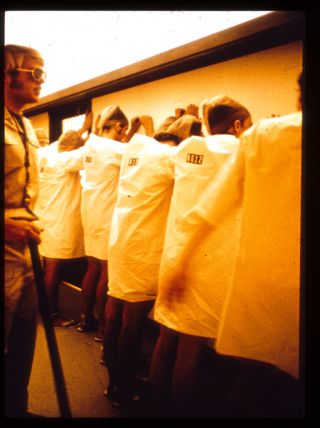
Stanford experiment “guards” make “prisoners” face the wall.
Supply: PrisonExp web site, used with persmission.
Zimbardo had run what would grow to be probably the most best-known and maximum influential mental research ever carried out (BetterHelp, 2024; Cherry, 2022; Fescoe, 2016; Wintry weather, 2017), and indisputably a few of the maximum debatable (Inexperienced, 2016; Jarrett, 2014; Seaver, 2023; Stamp, 2019). Construction upon a scholar’s previous, not-so-famous thought and college mission, Zimbardo introduced what was once intended to be a two-week learn about. In his mock prison, one workforce of scholars was once solid to play the function of guards whilst the remainder of the volunteers would grow to be the prisoners, every assigned to his respective experimental workforce by way of the turn of a coin. “Guards” wore uniforms, carried billy golf equipment, and enforced laws, while “prisoners” wore humiliating outfits, extra like one thing out of One Flew Over the Cuckoo’s Nest than a real jail, and stayed as a rule locked in makeshift cells. All members—together with Zimbardo himself within the function of jail superintendent—were given stuck up within the simulation. Plenty of guards became imply, devising merciless and degrading routines for the prisoners, lots of whom broke down, rebelled, or just became apathetic.
Archival content material research, together with knowledge on Zimbardo’s early assembly with the guards, point out that he had conveyed to them his expectancies for a way unhealthy issues would possibly get for prisoners. Worse than putting in the opportunity of excessive, not-so-subtle call for traits—by which an experimenter’s expectancies and enusuing movements motive a learn about’s effects to evolve to their hypotheses as a substitute of continuing organically—his dialogue with the guards has been interpreted by way of some as outright directing them to act as they did (Bartels, 2019; Le Texier, 2019). With each player realizing whether or not they have been guards or prisoners, the process was once already in contrast to that of a placebo-versus-drug learn about. The jail learn about clearly may no longer had been single-blind, by which no player is aware of which workforce they are in, a lot much less double-blind, by which neither the members nor the researcher or assistant who interacts with them is aware of anyone’s experimental situation. Generally, even in a roleplay learn about, members in a social psychology experiment would a minimum of be unaware of the hypotheses, however the ones taking part in guards knew what the researcher anticipated of them.
As Zimbardo later instructed social psychologist David Myers (1993), “We’ve got taken the message of our simulated jail learn about—the corrupting energy of the jail scenario—to jail officers, judges, legal professionals, and committees of the U.S. Senate and Space. That ‘excellent other folks’ might be so liable to the ‘evil forces’ in a simulated atmosphere demanding situations us to reevaluate assumptions in regards to the reasons of social and private pathology.” The experiment’s flaws would possibly conceivably generalize to the true global, too, the place employers, tycoons, elected officers, and advisors at the back of the scenes solid others within the roles of staff, servants, constituents, and possibly sufferers in their insurance policies and manipulations.
All through our advance viewing of Quiet Rage, the vice-president of the Soviet Mental Society took place to take a seat a couple of ft clear of me. All through the post-screening Q&A, the person raised his hand and when known as upon, shared via his interpreter an epiphany that had struck him as he’d watched: He’d learned that his complete nation had simply pop out of a decades-long enjoy by which that experiment were carried out on a societal scale. Zimbardo later instructed Myers, “He mentioned the Communist rulers assigned the general public to play the jobs of prisoners and the remaining to be guards in a 70-year-long experiment. Now that it’s formally over, he puzzled whether or not the topics will have discovered their roles too smartly and would no longer be capable to shed them even if they have been loose to take action.”
That was once 1991. The place are we now?
Left to their very own gadgets, a few of Zimbardo’s guards pitted prisoners towards every different. To squelch one younger guy’s rebelliousness, as an example, guards directed others within the prisoner workforce to chant, “Prisoner 819 did a foul factor,” again and again till the persecution overwhelmed no longer best his resistence however his spirit as smartly. Outnumbered by way of inmates, actual jail guards now and again push prisoners to understand fellow inmates as threats. Guards would possibly condone bullying, prod prisoner-on-prisoner aggression, stir the embers of rival jail gangs’ enmity, gasoline racial warfare, incite violence between incarcerated teams, or just fashion endured aggression (Denans & Léon, 2016; Larson, 2014). Regardless of how few guards strive this, pitting prisoners towards one any other prevents them from uniting towards their keepers.
In one-panel caricature that has long past viral, artist Denis Lushch depicts 3 males sitting a desk: one darker-skinned guy in a T-shirt who has not anything in entrance of him, a older guy in trade go well with with a pile of cookies, and a hardhat-wearing employee with only one cookie on his another way naked plate. The businessman tells the employee, “Cautious, mate…that foreigner needs your cookie!” Regardless that outnumbered by way of the ones poorer than himself, the businessman manner to stay everybody with much less privilege distrustful of each other so they don’t realize how a lot he is hoarding. He belongs to the category of the jail warden or superintendent who helps to keep the prisoners from making an allowance for how simply he can finish all their torment. His phrases paintings to make his socioeconomic servants and prisoners shackle themselves. Getting them to concentrate on the issue at a decrease, smaller degree whilst growing the appearance that they see the massive image distracts them from spotting the larger downside or figuring out sensible answers. Distracted and divided, offended and afraid and wanting tangible goals for his or her emotions, they fail to combat the larger combat.





![VVS: Meet the Emerging K-Pop Woman Crew Set to Shine Like Diamonds [Teaser Images] – Kpoppie](https://i0.wp.com/kpoppie.com/wp-content/uploads/2025/04/vvs-man-100.jpg?w=100&resize=100,100&ssl=1 "VVS: Meet the Emerging K-Pop Woman Crew Set to Shine Like Diamonds [Teaser Images] – Kpoppie")





You must be logged in to post a comment Login