


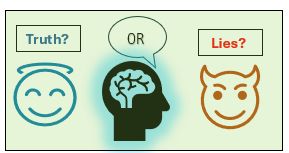
Cognition can become selections to lie or inform the reality.
Supply: Debbie Peterson
Within the first (2020) find out about of its type, Erasmus College researchers Speer, Smidts, Maarten, and Boksem, the use of magnetic resonation imagery (MRI), discovered biologically constant neural activation and connectivity patterns that differentiate fair from cheating people. Their find out about confirmed the mind task in play all the way through decision-making when fair other folks lie or liars make a choice honesty.
Findings of important person variations within the general quantity of dishonest recommend that individuals are allotted alongside a continuum from people who are constantly fair (20%), whose default habits is fair, to cheaters who constantly default to dishonesty (5%).
Task in 3 mind areas finds why the similar individual might cheat on some events and stay fair at different occasions. Via looking at task within the spaces of the mind that replicate self-referential pondering, cognitive keep an eye on, and praise, the researchers can classify cheaters as opposed to fair people. The organic mechanism that modifies the ones behaviors is dependent upon cognition.
Truthful Selections vs. Dishonest
Folks with a default inclination to be fair when given the chance to cheat go together with their self-image as “fair” and behave in truth. A community of 3 spaces of the cortex promotes honesty. Neural proof suggests that once uncovered to a chance to cheat, in particular fair other folks price their ethical self-concept and its repairs sufficient to forgo doable monetary praise. Truthful individuals are motivated to uphold their self-concept even though it comes at the price of doable financial features as a result of they weigh the conflicting motivations to procure a financial praise as opposed to the long-term function of keeping up a favorable self-image. This displays up on MRIs as connections between 3 nodes of mind task that disappear when truth-tellers lie. To lie, truth-tellers will have to alter their self-image to deal with a lie.
Simply Rewards
Against this, people with a default inclination to cheat make selections pushed extra strongly through rewards. The researchers point out that the a part of the mind conscious of rewards isn’t moderated through morality, permitting greed to pressure fraud. Different findings of collective analysis into dishonest as opposed to honesty over the last 3 many years verify that grasping individuals are extra susceptible to withhold data from others in negotiation settings, have interaction in more than a few ethical transgressions extra steadily, and to find transgressions extra appropriate than much less grasping people. Grasping individuals are additionally much more likely to take bribes and better bribes.
Then again, recent research additionally to find that folks care about greater than best maximizing their very own financial payoff, which is mirrored within the top incidence of altruism and reciprocity in mental research of honesty and within the selections through liars to inform the reality when they’ve consciousness of the sufferers in their lies.
Judgment of right and wrong and Compromise
The researchers had been in a position to evaluate why a in most cases fair individual makes a decision to cheat and why a cheater would possibly chorus from dishonest on some events.
For each fair and cheating other folks, task in spaces related to cognitive keep an eye on moderates their habits. For the fair, it would advertise dishonest, and for cheaters, it is helping them be fair. A number of strains of study suggest that cognitive keep an eye on is had to get to the bottom of this pressure between praise and self-concept. For truth-tellers, this struggle is steadily settled with a compromise through which individuals behave dishonestly sufficient to make the most of the chance to cheat however in truth sufficient to deal with a favorable self-image. Cognitive keep an eye on performs a an important position in resolving this struggle.
An individual’s ethical default determines the position of cognitive keep an eye on. A in most cases fair individual will want to conquer the default of being fair to make the most of dishonest every so often, while a cheater must inhibit the main egocentric reaction to be fair. To act in truth, cheaters must exert cognitive keep an eye on to override their grasping inclinations and will have to do to be able to a better stage than fair other folks. Via looking at the organic markers, the find out about as it should be classifies unseen individuals as cheaters or cheaters as fair people between 75% and 84% of the time.
This find out about was once a small pattern of 25 people. Nonetheless, it generated constant effects that may be cross-validated for replication in long run research to supply helpful neuroimaging-based biomarkers of honesty and dishonesty that make bigger the sphere of neuro-forensics and supply organic markers that reinforce mindfulness of honesty within the boardroom through adopting honesty norms and relief of dishonest through mindfulness of the hurt suffered through sufferers of dishonesty.





![VVS: Meet the Emerging K-Pop Woman Crew Set to Shine Like Diamonds [Teaser Images] – Kpoppie](https://i0.wp.com/kpoppie.com/wp-content/uploads/2025/04/vvs-man-100.jpg?w=100&resize=100,100&ssl=1 "VVS: Meet the Emerging K-Pop Woman Crew Set to Shine Like Diamonds [Teaser Images] – Kpoppie")




You must be logged in to post a comment Login